Nearly 9 out of 10 video companies now use AI
One technology that has had a clear impact on the video sector in recent years is AI. Artificial intelligence is increasingly becoming part of the daily practice of production companies, agencies, and creative studios. This is evident from a survey of 46 companies that submitted a video to Video Experience Day. But how widely is AI actually being used in the video production process today? In which stages of production are companies using the technology? And how do video producers perceive the use of AI?
AI has become an integral part of the video landscape
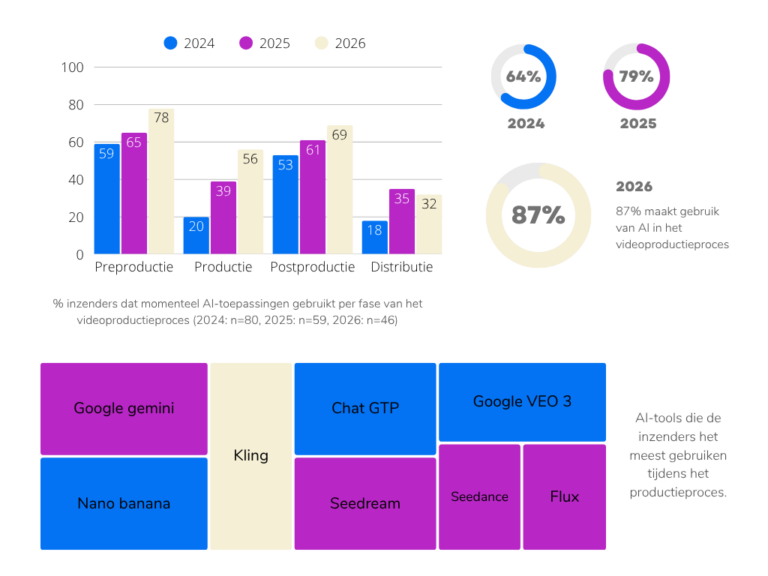
AI is no longer a tool for early adopters. It has clearly become embedded in the Belgian video landscape. This is evident from a recent survey of 46 companies that submitted a video to Video Experience Day. In 2026, 87 percent of the surveyed companies indicated that they use AI in their video production process. This represents another increase compared to 2025 and 2024, when 79 percent and 64 percent respectively reported using AI.
AI still has significant growth potential during the production phase
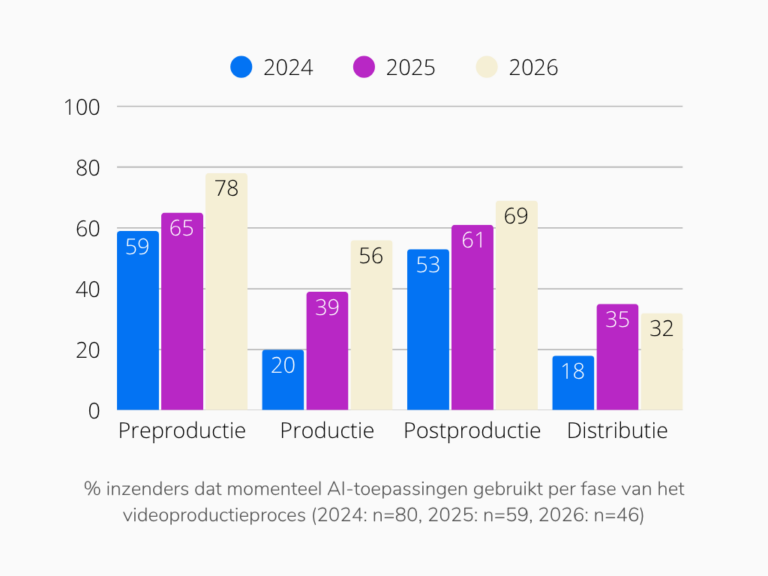
When looking at the different stages of the video production process, the strongest growth can be observed in the production phase. In 2024, 20 percent of respondents used AI during production. This increased to 39 percent in 2025 and 56 percent in 2026. Researcher Karen Pauwels (AP University of Applied Sciences and Arts) explains: “This evolution suggests that the rapid improvement of AI video tools has significantly increased their practical usability. Whereas AI video was often unpredictable or insufficiently mature a few years ago, the technology is now increasingly seen as a valuable component of the production process.”
The open-ended responses reflect the same shift. Respondents indicate that they use AI during production for generating footage that is difficult or expensive to film, bringing photographs to life, creating characters and environments, and generating animations or video footage. At the same time, AI is also being used during this phase to reduce production time and production costs.
Video producers use AI most frequently during pre-production
Pre-production remains the stage in which AI is used most extensively. In 2026, 78 percent of the surveyed companies reported using AI during this phase. The open-ended responses confirm that AI has become well established as a tool for brainstorming, concept development, scriptwriting, mood boards, storyboard images, and visual references. Post-production also remains an important application area, with 69 percent of companies using AI for tasks such as upscaling, audio cleanup, generative fill, color grading, subtitling, and transcription.
The use of AI also continues to increase in both pre-production and post-production. In these stages, the applications largely correspond to those reported in previous years. The production phase tells a different story. Although the figures show substantial growth, practical adoption remains more dependent on the further development of video tools, particularly in terms of consistency, control, and reliability. AI use in distribution, on the other hand, has declined. “This may be because video production companies are often less involved in the distribution of the videos they produce and therefore have less visibility into this stage,” says researcher Ilse Van Looveren (AP University of Applied Sciences and Arts).
AI video tools are gaining ground
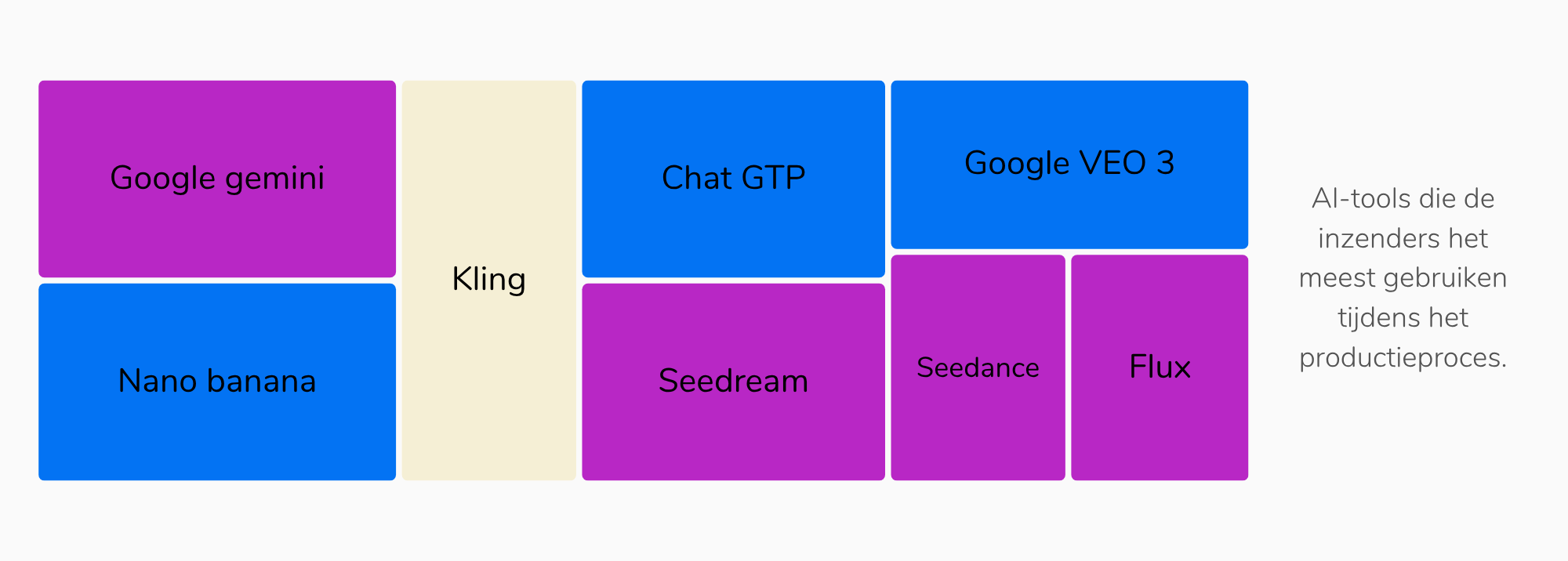
The increasing use of AI for video creation during production is also reflected in the AI tools being used. Whereas in 2025 text-based tools and image generators such as Midjourney, ChatGPT, ElevenLabs, and Adobe Firefly were the dominant solutions, video generation tools are now appearing more frequently. Kling, Google Veo 3, and Seedance have entered the list alongside text tools such as ChatGPT and Google Gemini, and image tools such as Nano Banana, Seedream, and Flux.
“The shift in tools shows that video producers are moving away from searching for a single impressive generated image and are increasingly looking for controllable and consistent video workflows,” explains researcher Karen Pauwels (AP University of Applied Sciences and Arts). “This is reflected, for example, in the fact that image generators that were previously popular, such as Midjourney, are no longer mentioned, while tools such as Nano Banana have become among the most frequently cited. These tools enable creators to generate multiple variations and camera angles from a single character, scene, or visual style without completely losing consistency. These images can then be converted into moving footage through image-to-video workflows. This is particularly relevant for video production, where different scenes often need to maintain the same visual identity and where brands require control over how products, people, and visual styles are represented.”
AI delivers moderate efficiency gains
Although nearly 9 out of 10 companies use AI, this does not yet translate into substantial efficiency gains for everyone. When asked in the open-ended survey how they use AI, respondents most frequently referred to efficiency and workflow acceleration. They mentioned working faster, increasing output, automating repetitive tasks, shortening production timelines, and reducing production costs. AI is therefore clearly seen as a tool for accelerating the production process.
At the same time, a separate question about the actual impact on efficiency shows that only 13 percent of respondents reported a significant improvement, while 38 percent experienced a moderate improvement. In addition, 33 percent answered “not applicable.” “AI is therefore widely used with efficiency as an important motivation, but the gains are probably not yet systematically measured or experienced as transformative,” says researcher Ilse Van Looveren (AP University of Applied Sciences and Arts). “At present, AI appears to deliver incremental time savings rather than fundamental efficiency gains.”