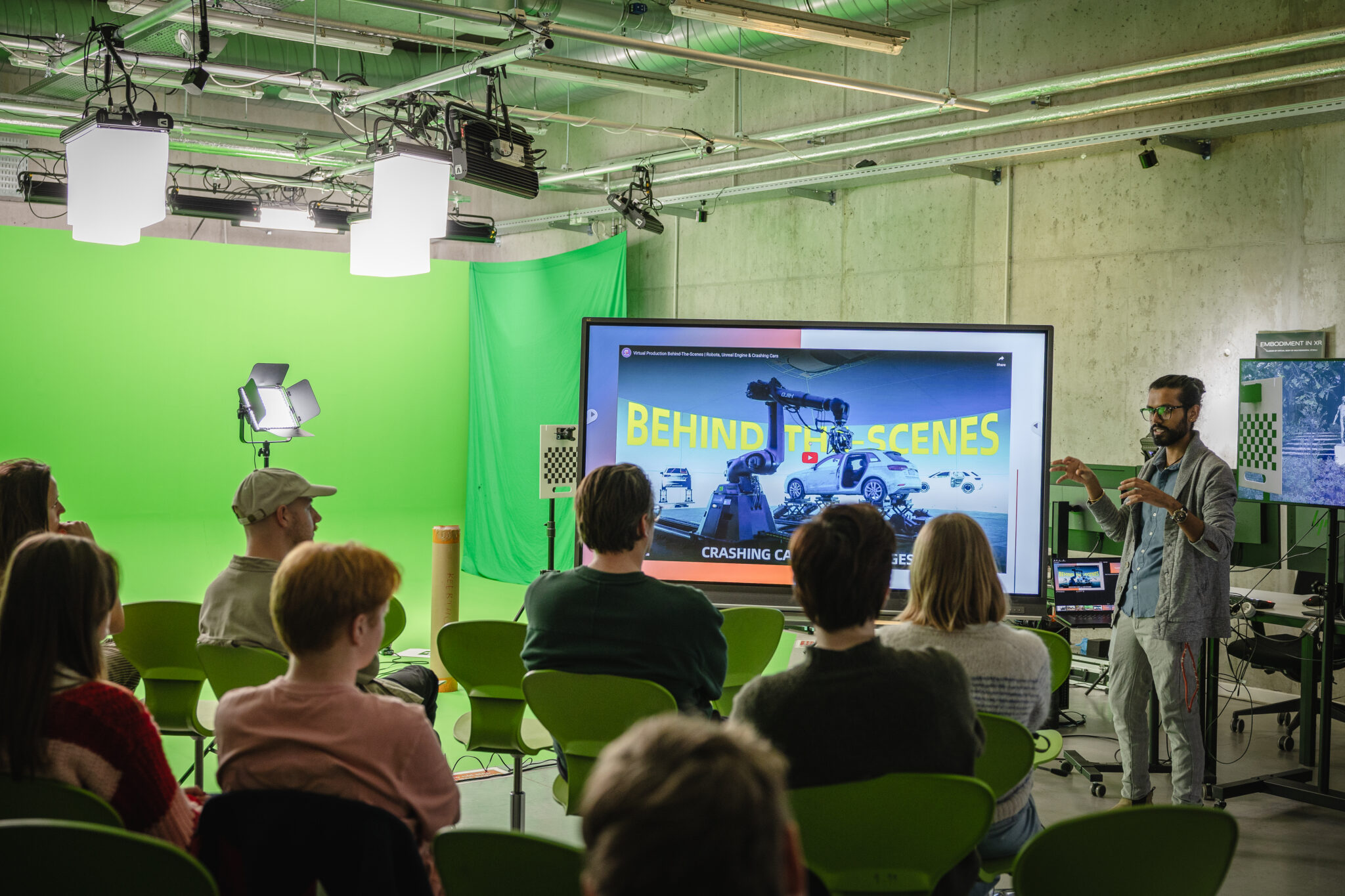
Under the theme of the third edition of TINCfest: ‘Let’s TINC Beyond’, researchers from the Immersive Lab explored the future of video, image making and virtual production. The inspiration session did not just highlight technological trends, but also raised fundamental questions about the evolving role and mindset of the videomaker. Two sessions stood out in particular. Beyond Formats and Beyond Dimensions.
Beyond Formats
In Beyond Formats, Karen Pauwels, researcher at Media, Design & IT and Immersive Lab (AP Hogeschool), examined the rapidly changing landscape of video production. The rise of AI generated content is fundamentally reshaping how video is created, while organisations rely more than ever on visual communication to connect with their audiences.
Traditional formats and workflows are under pressure. Today, almost anyone can create, publish and experiment, while technology increasingly sets the pace. This forces videomakers to rethink their role from the ground up. The videomaker is no longer just an executor, but becomes a curator, director and strategist operating within an ecosystem of intelligent tools.
A striking part of the session focused on the growing use of AI avatars within brand and customer experiences. Many companies are actively exploring how virtual personas can become part of their public facing communication. A widely known example is TUI, which launched the AI influencer Lena. She is designed to appear in multiple locations around the world at the same time. The key advantage is efficiency. Lena never travels, never gets tired, and significantly reduces costs. In TUI retail stores, visitors are now often greeted by an AI avatar rather than a human employee, making AI the very first point of contact.
Other brands take a different route. Basic-Fit uses a stylized cartoon AI avatar, allowing the brand to move away from its purely budget oriented image while still offering customers a personal AI coach. In the entertainment sector, Studio Xicoia introduced what they describe as the first AI actress, Tilly Nortwood. The studio plans to expand its casting agency with AI talent. Founder Eline Van der Velden framed this as a new creative category, stating that there are now three genres: animation, traditional live action, and an AI genre. Tilly was always intended to exist purely within that AI space. While this direction sparked strong interest, audience reactions during the session suggested that full trust in AI avatars has not yet been achieved.
At the same time, world model and character consistency tools continue to evolve at a rapid pace. New systems make it possible to generate highly consistent characters across images and video. Lena herself was created by generating a large image set and then training a LoRA model on that dataset. This points to a broader trend in which character creation becomes more accessible and more controllable. As a result, AI generated commercials are becoming increasingly common. Recent holiday campaigns from McDonald’s and Coca-Cola clearly illustrate this shift. Notably, Coca Cola submitted a second AI driven campaign despite strong public criticism of the first.
Voice technology is following a similar trajectory. ElevenLabs is positioning itself as a dominant player by partnering with actors such as Matthew McConaughey and Michael Caine. The company offers licensed celebrity voices through a marketplace that focuses on premium voices requiring individual agreements, rather than unrestricted automated use.
On the three dimensional side, AI assisted asset creation is also making a leap forward. Where earlier approaches often resulted in low quality models, new tools now enable the creation of detailed and production ready three dimensional assets directly from photographs. This marks a significant step for AI supported three dimensional workflows.
AI is also increasingly embedded in mainstream film and television production. In the series House of David, no fewer than seventy two shots in the first season were created using AI. According to the producer, AI did not replace jobs, but allowed the team to raise the production value while keeping costs under control.
Despite this rapid adoption, a strong counter movement is clearly visible. Authenticity is becoming more important than ever, and user generated content is gaining relevance. More creators openly share their creative journeys and production processes. Transparency around AI usage is also increasing, with subtitles, newsletters or credits explicitly stating how and where AI was used. The underlying message resonated strongly throughout the session. Transparency builds trust.
Beyond Dimensions
While Beyond Formats focused on the profession itself, Beyond Dimensions zoomed in on the technological foundations of virtual filmmaking. Keerthanan Vignarajah, researcher at the Immersive Lab (AP Hogeschool), offered a behind the scenes look into his daily research practice.
Participants discovered how recent innovations in photogrammetry and gaussian splatting are reshaping the virtual film landscape. These techniques make it possible to capture spaces, objects and even performances in ways that increasingly blur the line between live action and digital environments.
In a market flooded with new tools and bold promises, Keerthanan Vignarajah takes on the role of a critical filter. He separates meaningful innovation from short lived hype and focuses on technologies with long term relevance for filmmakers. His ambition is clear. To bring structure to the chaos and to encourage filmmakers to experiment with emerging film techniques that have the potential to endure.